
Six claims about DGCA examinations circulate constantly, and most of them are wrong. Each one below is checked against what DGCA actually publishes — CAR Section 7, Series ‘B’, Part I for eligibility, and the Flight Crew FAQ on the Pariksha portal for procedure. Where the rules are silent, we say so rather than filling the gap.
Key facts
- To appear in Private Pilot Licence theory examinations, DGCA requires a pass in Class Ten or equivalent.Sourced: CAR Section 7, Series B, Part I
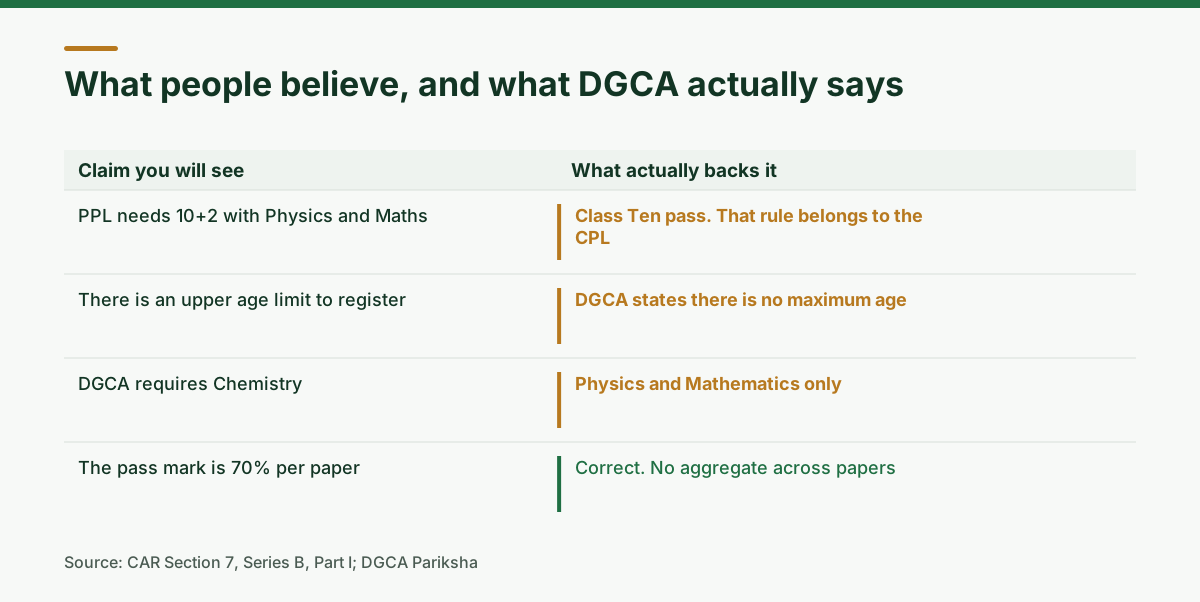
- The 10+2 with Physics and Mathematics requirement belongs to the Commercial Pilot Licence, not the PPL.Sourced: CAR Section 7, Series B, Part I
- DGCA states there is no maximum age limit to register as a Flight Crew candidate.Sourced: DGCA Pariksha Flight Crew FAQ
- A cleared PPL paper is valid for two and a half years, against five for CPL and ATPL.Sourced: CAR Section 7, Series B, Part I
On this page
- “You need PCM — Physics, Chemistry and Mathematics”
- “The PPL and CPL requirements are the same”
- “There is an upper age limit”
- “Ground classes are mandatory”
- “There is a limit on attempts”
- “Indian candidates need a passport to register”
- “Submitting the online form is enough”
- How to check a claim yourself
- Frequently asked questions
“You need PCM — Physics, Chemistry and Mathematics”
Wrong. The stated requirement for appearing in Commercial Pilot Licence theory examinations is a pass in 10+2 standard with Physics and Mathematics from a recognised board. Chemistry is not part of it.
This matters practically. Candidates who took Physics and Mathematics without Chemistry are told regularly that they are ineligible, and some abandon the route on that basis. They are eligible.

“The PPL and CPL requirements are the same”
Wrong, and this is the most consequential one. To appear in Private Pilot Licence theory examinations, DGCA requires a pass in Class Ten or equivalent — not 10+2, and not Physics and Mathematics. The 10+2 PCM rule belongs to the CPL.
The validity differs too. A cleared PPL paper is valid for two and a half years. A cleared CPL or ATPL paper is valid for five. Plan a PPL around the shorter window, because almost nothing published online states it.

“There is an upper age limit”
Wrong. DGCA states there is no maximum age limit to register as a Flight Crew candidate.
The confusion is real but misplaced: airlines set age ceilings for cadet programmes and recruitment. Those are employer conditions, not licensing ones. A licence and a job are different questions, and only the second has an age attached.

“Ground classes are mandatory”
Wrong — and we teach ground classes, so read that with whatever scepticism you think it deserves, then check the rule.
The eligibility conditions for appearing are a computer number issued by the Central Examination Organization and the educational qualification for your licence category. Ground school attendance appears nowhere in them.
What is true: your Flying Training Organisation may require a ground phase under its own training contract. That is an obligation to that school, not to the regulator. We have written separately on whether classes are worth paying for, which is the honest question.

“There is a limit on attempts”
Not stated. Neither the eligibility CAR nor the Flight Crew FAQ publishes an attempt cap, so we do not claim one exists or that none does.
What genuinely constrains you is different and more useful to plan around: paper validity, and cost. Each attempt is a fresh fee of Rs 2,500 that is never refunded, and a cleared paper is only useful while it remains valid. The real limit is arithmetic, not a rule.
“Indian candidates need a passport to register”
Wrong. Indian candidates do not need a passport at all. A passport is mandatory for foreign candidates, including those from Nepal and Bhutan, and for foreign nationals the passport address becomes the permanent address on record. Foreign nationals additionally need an Indian mobile number before registering and security clearance submitted in quintuplicate.
“Submitting the online form is enough”
Wrong for new candidates. A computer number is not generated automatically on submission. DGCA scrutinises the online application against a hard copy posted to the Central Examination Organization, and only then allots the number. New candidates also need a Board Verification Certificate for their mark sheets before registration.
The full procedure, including document formats and photograph specifications, is in our DGCA computer number guide.
How to check a claim yourself
Two documents settle almost every eligibility question:
- CAR Section 7, Series ‘B’, Part I — who may appear, in which subjects, at what pass mark, with what validity.
- The Flight Crew FAQ on the Pariksha portal — computer numbers, documents, fees, procedure.
Frequently asked questions
Is PCM required for DGCA exams?
No. DGCA requires 10+2 with Physics and Mathematics for the Commercial Pilot Licence. Chemistry is not part of the stated requirement. For the Private Pilot Licence the requirement is a pass in Class Ten or equivalent.
Is there an age limit for DGCA exams?
DGCA states there is no maximum age limit to register as a Flight Crew candidate. Age ceilings belong to airline recruitment and cadet programmes, which are separate from DGCA registration and licensing.
Are DGCA ground classes compulsory?
No. CAR Section 7, Series B, Part I lists a computer number and the educational qualification as the conditions for appearing. Ground school attendance is not among them. A flying school may still require it under its own contract.
How many attempts do I get at a DGCA paper?
DGCA does not publish an attempt cap in the eligibility CAR or the Flight Crew FAQ. What does bind you is validity: a cleared CPL or ATPL paper lasts five years, a PPL paper two and a half, and every attempt costs a fresh non-refundable fee.
Does a good score in one paper make up for a weak one?
No. The pass mark is 70% in each paper and there is no aggregate across papers.
Do I need a passport to register with DGCA?
Indian candidates do not. A passport is required for foreign candidates, including candidates from Nepal and Bhutan, whose passport address becomes the permanent address on record.
If a claim about DGCA eligibility is not in one of those, treat it as unverified — including anything on this page. Rules are revised; check pariksha.dgca.gov.in before you act on a number.
More: the FAQ for short sourced answers, the glossary for the terms, and our editorial policy for how these figures are checked.
- DGCA Exams
- DGCA Eligibility
- CPL Requirements
- Pilot Training Myths
Sources
Every figure above traces to one of these documents. Where a claim could not be sourced, the page says so instead of repeating it.
- CAR Section 7, Series B, Part I
- DGCA Pariksha Flight Crew FAQ
Related reading
- DGCA ExamsDGCA Exam Validity and Attempts: What Is Published, and What Is NotA cleared CPL or ATPL theory paper stays valid five years. A cleared PPL paper stays valid two and a half. DGCA publishes no limit on attempts, so what actually constrains you is that window and a non-refundable fee on every try.
- Choosing TrainingDGCA Ground Classes vs Self-Study: Which Route Actually Clears the Exams?TL;DR: DGCA ground classes are not mandatory. CAR Section 7, Series B, Part I requires only a DGCA computer number and a 10+2 pass with Physics and Mathematics to appear for CPL theory papers. Ground classes are a study decision, not a licensing one — worth buying for Air Navigation and Air Regulation, and usually skippable for Technical General and Meteorology if your PCM base is current.
- DGCADGCA Exam Pass Rate: What the Data Actually ShowsTL;DR: DGCA does not publish a pass rate for CPL or ATPL theory papers. Every specific percentage circulating online is an estimate from a coaching site, not a regulator figure. What is actually knowable: each paper is graded independently at 70%, papers stay valid five years, and your own mock scores predict your result far better than any population statistic.