DGCA Ground Classes vs Self-Study: Which Route Actually Clears the Exams?
TL;DR: DGCA ground classes are not mandatory. CAR Section 7, Series B, Part I requires only a DGCA computer number and a 10+2 pass with Physics and Mathematics to appear for CPL theory papers. Ground classes are a study decision, not a licensing one — worth buying for Air Navigation and Air Regulation, and usually skippable for Technical General and Meteorology if your PCM base is current.
Flying Star Aviator Academics Team·15 min read·Last verified
DGCA CPL & ATPL ground instruction, Dwarka, New Delhi. Figures on this page are checked against the regulator’s own documents — how we check them.
Key facts
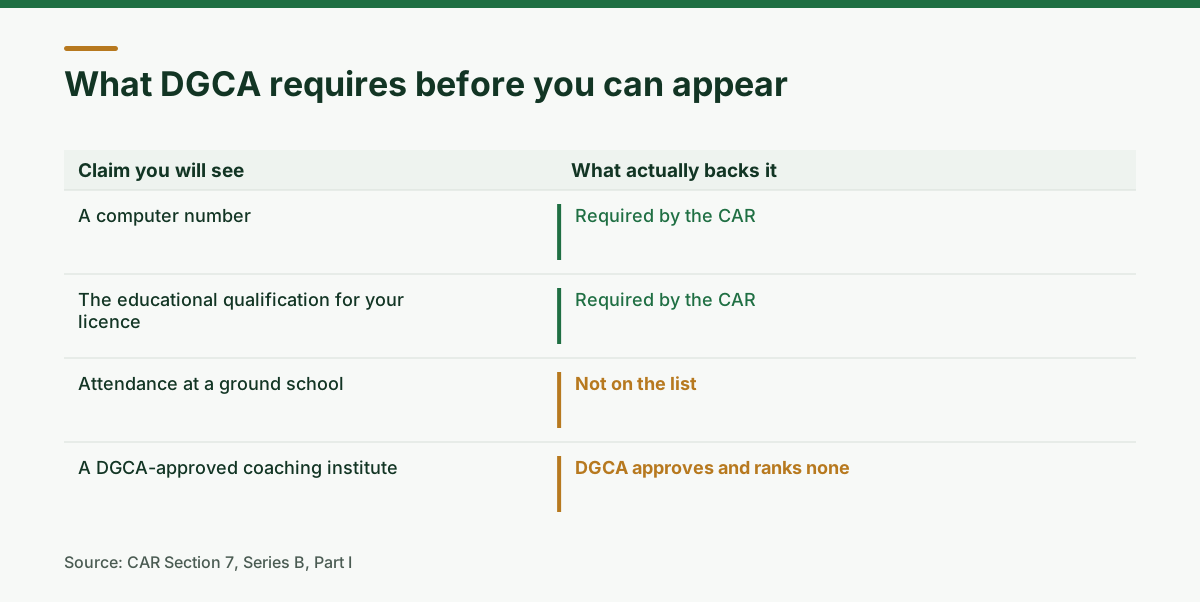
CAR Section 7, Series B, Part I asks for two things before you can appear: a computer number, and the educational qualification for your licence category. Ground classes are not on the list.Sourced: CAR Section 7, Series B, Part I
The pass mark is 70% in each paper, with no aggregate across papers.Sourced: CAR Section 7, Series B, Part I
A cleared CPL or ATPL paper stays valid for five years.Sourced: CAR Section 7, Series B, Part I
You do not need to attend ground classes to sit the DGCA theory exams. DGCA Civil Aviation Requirements, Section 7, Series B, Part I asks for exactly two things before you can appear: a computer number issued by the Central Examination Organisation, and a pass in Class 10+2 with Physics and Mathematics. Coaching is a study decision. It is not a licensing requirement.
That single fact changes the question. You are not asking whether ground classes are allowed or required. You are asking whether paying for structured teaching gets you through five papers at 70% faster and cheaper than teaching yourself would. This guide answers that with the rulebook, the real exam economics, and an honest read on who belongs in each camp.
Are DGCA ground classes mandatory in India?
No. The eligibility clause for CPL theory papers lists a DGCA-issued computer number and 10+2 with Physics and Mathematics from a recognised board. Attendance at a ground school appears nowhere in it. You can register on the Pariksha portal, pay the paper fee, and write the exam on your own preparation alone.
Three distinctions trip up almost every new candidate:
Ground school is not flying school. Your Flying Training Organisation handles flight hours, aircraft and instructor supervision. Ground classes handle theory for the written papers. They are separate purchases, often from separate providers, and clearing one does nothing for the other.
Your FTO’s internal policy is not DGCA law. Many flying schools bundle a ground phase into the course fee and make attendance a condition of their own training contract. That is a contractual obligation to that school, not a regulatory one.
RTR(A) sits outside this entirely. The Radio Telephony Restricted (Aeronautical) licence is a separate examination with its own syllabus and its own practical component. Administration of RTR(A) has been moving between the WPC wing of the Ministry of Communications and DGCA, so confirm the current examining authority on the official portal before you apply.
What the DGCA actually tests you on
Before comparing study methods, be precise about the target. A CPL candidate writes four theory papers; an ATPL candidate writes a partly different set. Every paper is written to a published syllabus and prescribed reading list, both available on the DGCA Pariksha portal.
Paper
Applies to
What it demands from you
Air Navigation
CPL and ATPL (separate papers)
Chart work, dead reckoning, time and speed calculation, flight planning. The most calculation-heavy paper and the one where practice volume beats reading.
Aviation Meteorology
CPL and ATPL
Atmosphere, pressure systems, cloud and precipitation, icing, thunderstorms, Indian monsoon behaviour, decoding METAR and TAF.
Air Regulation
CPL and ATPL (common paper)
ICAO Annexes, Indian Aircraft Rules, DGCA Civil Aviation Requirements, licensing and flight-time limitations. Memory-heavy and updated often.
Technical General
CPL and ATPL (common paper)
Principles of flight, airframes, powerplants, instruments, electrics, aircraft general knowledge.
Technical Specific
CPL and ATPL
Systems and performance of the specific aircraft type you nominate. Your source material is the aircraft manual, not a coaching handout.
Radio Aids and Instruments
ATPL
Radio navigation, VOR, ADF, ILS, RNAV and the instrument suite.
Two rules shape every study plan built around these papers:
The pass mark is 70% in each paper. There is no aggregate. A 92 in Meteorology does not carry a 64 in Air Navigation.
A cleared CPL or ATPL paper stays valid for five years. That validity window is what makes staged, paper-by-paper preparation viable instead of an all-or-nothing sprint.
Illustration in production
The trade is money against time, and it is not the same for everyone.
What it costs to write the papers
Exam fees are fixed by DGCA and are the same whether you studied alone or paid a lakh for classes. They are also the clearest number in this whole decision, so plan around them.
Route
Fee per paper
How it works
Regular session
₹2,500
Fixed session dates announced by public notice. You apply in the window, sit on the scheduled date.
Online On-Demand Examination (OLODE)
Not separately published
You pick a slot from the available list rather than waiting for a session date. DGCA’s FAQ states ₹2,500 per paper for Flight Crew examinations and names no distinct OLODE fee. A ₹5,000 figure circulates widely with no primary source behind it, so confirm the amount in the portal before paying. Fees are not refunded or adjusted after submission.
Do the arithmetic before you decide how casually to attempt a paper. Four CPL papers at ₹2,500 is ₹10,000 if every one clears first time, and each resit is another full fee plus the months to the next window. A failed attempt is never just a delay.
Illustration in production
What a ground-class fee actually buys.
Self-study for DGCA exams: what it actually demands
Self-study works, and plenty of licence holders got there that way. It asks for something most candidates underestimate: the ability to build a syllabus map, source correct material, and hold a schedule for six to nine months with nobody checking on you.
What you gain
Cost. Your outlay is books, the exam fees, and a question bank subscription if you buy one. Nothing else.
Pace control. You spend three weeks on Air Navigation if you need three weeks, and skip ground you already hold from a physics or engineering background.
Geography stops mattering. No commute, no relocation to Delhi or Mumbai for a class schedule.
It builds the habit the licence needs anyway. Type ratings, recurrent checks and route manuals are all self-directed reading. Starting that discipline early pays for the rest of a career.
What it costs you
Syllabus drift. The published syllabus and prescribed books are broad. Without someone marking the boundary, candidates over-read Meteorology and under-read the Indian regulatory content that Air Regulation leans on.
Stale material. Air Regulation moves. CARs get revised, circulars supersede circulars. A used book bought three years ago will teach you an answer that is now wrong. This is the single most common self-study failure and it is invisible until results day.
No calibration. You cannot tell whether your 70% is comfortable or borderline until the DGCA tells you, and by then you have paid the fee.
Navigation numericals. Chart work and flight-planning problems are where most solo candidates stall. Reading the method is not the same as being corrected on your own working.
DGCA ground classes: what you are actually paying for
A ground class is not a room where someone reads a textbook aloud. What you are buying, when it is done well, is scope control, current regulation, and correction. Anything less and you have paid for a study hall.
What you gain
A bounded syllabus. An instructor who has taught the papers for years knows what the examiner asks and what the book covers but the paper never touches. That boundary is the product.
Current regulation. A working ground school tracks CAR revisions and circular changes because its results depend on it. You inherit that maintenance instead of doing it yourself.
Worked correction. Somebody looks at your Air Navigation working and tells you where the error entered. Nothing in self-study replaces that.
Pace enforcement. A fixed timetable converts a nine-month intention into a nine-month schedule. For most candidates this is the real value, whatever they tell themselves.
A cohort. Classmates sitting the same session share notices, portal deadlines and question patterns. Isolation is expensive in a process this procedural.
What it costs you
Money. A full CPL ground package is a five-figure commitment before you have paid a single exam fee, and it is not recoverable if you drop out.
Fixed pace, both directions. The class moves at the cohort’s speed. If you are strong in Technical General you will sit through hours you did not need.
Variable quality. The gap between a well-run ground school and a poorly-run one is enormous, and the fee does not reliably tell you which you have found.
False security. Attendance is not preparation. Candidates who sat through every session and never worked past papers fail at the same rate as anyone else.
Illustration in production
One path splitting and rejoining, with a shorter branch through a classroom.
Ground classes vs self-study: side-by-side
Factor
Self-study
Ground classes
Required by DGCA
No
No
Direct cost
Books, question bank, exam fees
Course fee plus all of the above
Typical time to exam-ready
Six to twelve months, highly variable
Four to eight months on a fixed timetable
Syllabus scoping
You do it, and errors stay hidden
Done for you if the school is competent
Regulation currency
Your responsibility to track
Maintained by the provider
Air Navigation numericals
Hardest part to self-correct
Where classroom time pays best
Discipline
Entirely internal
Externally enforced
Risk of repeat exam fees
Higher without calibration
Lower with mock testing
Suits
Strong PCM base, prior study discipline, tight budget
Long gap since Class 12, weak numericals, needs structure
Who should self-study for the DGCA exams?
Self-study is the right call if most of these describe you: you finished 10+2 with Physics and Mathematics recently and the numericals still feel familiar; you have cleared a competitive exam on your own before; you can hold twenty focused hours a week without supervision; and your budget makes a course fee a genuine strain rather than an inconvenience.
An engineering graduate with current maths, or a candidate already inside an FTO with instructors to ask, will usually get through Technical General and Meteorology alone. A sensible middle path is to self-study those two and buy teaching only for Air Navigation and Air Regulation.
Illustration in production
A plan that works on either route.
Who should join DGCA ground classes?
Take the classes if you left Class 12 more than two years ago and your maths has gone quiet; if you have already failed a paper; if you study well in a room and badly at a desk at home; or if you are on an FTO timeline where a lost session pushes your flying and your line-training slot by months.
The failed-paper case deserves emphasis. Repeating the same solo method that produced a 62 rarely produces a 71. The gap is almost never effort. It is usually scope or method, and both are what teaching corrects.
The hybrid route most candidates actually take
Framing this as a binary is the mistake. The pattern that works for the largest number of candidates is neither pure route. It looks like this:
Buy teaching for the two papers that punish you hardest. For most people that is Air Navigation, because of the numericals, and Air Regulation, because of how quickly it goes stale.
Self-study Technical General and Meteorology. Both are conceptually stable and well served by the prescribed books. If you have a PCM base, you can carry these alone.
Treat Technical Specific as its own project. Your source is the aircraft manual for the type you nominate. No general coaching package covers it properly.
Test yourself against past papers from month three, not month eight. Attempting papers early is diagnosis, not assessment. It tells you where to spend the next month.
Stage your attempts around the five-year validity. Sit two papers in one session rather than four half-prepared ones. A clear stays banked for five years; a fail costs a fee and a session.
How to judge a DGCA ground school before you pay
Fee is a poor signal of quality here, so use questions instead. Ask these before any deposit, and take a vague answer as an answer:
Which CAR revision is your Air Regulation material built on? A provider who cannot name it is not tracking regulation, which is the main thing you are paying for.
Who teaches Air Navigation, and what do they hold? Numericals need a teacher who has flown or examined, not a generalist reading slides.
How many mock papers, and are they marked with feedback? Unmarked mocks are attendance, not calibration.
Can I buy single papers? A school confident in its teaching will sell you Air Navigation alone. One that only sells full bundles is optimising its revenue, not your result.
What happens if I miss the session I was preparing for? Get the repeat-attendance policy in writing before you pay, not after.
Do you help with the Pariksha portal and the computer-number process? Procedural support is genuine value; a rejected application costs a session.
Ask former students directly rather than reading testimonials. The question that gets a useful answer is not “was it good” but “which paper did you clear first, and how many attempts did it take”.
What do DGCA ground classes cost in India?
Fees vary widely by city, by whether the package is full-time or weekend, and by how many papers it covers. Rather than quoting a range that will be wrong for your case, work out the number that matters to you:
Ask for the fee per paper, not per package. It makes providers comparable and lets you buy only what you need.
Ask what is excluded. Books, mock tests, portal assistance and repeat attendance are commonly charged separately.
Add DGCA exam fees on top: ₹2,500 per paper, per DGCA’s published FAQ.
Add the cost of a failure. A resit is another ₹2,500 plus the months to the next window. That is what a good course is actually insuring you against.
Any institute should give you a written per-paper fee and an inclusions list. If it will not, that is information too.
A six-month plan that works on either route
Month
Focus
Checkpoint
1
Computer number and portal registration. Begin Technical General while paperwork clears.
Computer number issued; prescribed book list confirmed from the official portal.
2
Technical General completed. Start Aviation Meteorology.
First past paper attempted cold, for diagnosis rather than score.
3
Meteorology completed. Begin Air Navigation from first principles.
Consistent 70% on Technical General past papers.
4
Air Navigation numericals, daily. Chart work and flight planning.
Working shown and corrected on at least thirty navigation problems.
5
Air Regulation against current CARs and circulars, never an old edition.
Two papers at exam-ready standard; session application filed on time.
6
Full-length timed mocks. Technical Specific from the aircraft manual.
Two consecutive mocks above 75% before you sit anything.
The 75% mock threshold is deliberate. Aiming at exactly 70 leaves no margin for a bad question set on the day.
Five mistakes that cost candidates an entire session
Studying Air Regulation from an outdated book. Verify every regulatory answer against the current CAR or circular. This one error accounts for more avoidable failures than any other.
Memorising a question bank instead of the method. Banks are for diagnosis. Papers reworded around the same concept will find you out.
Missing the application window. Exam applications open by public notice and close hard. Physical documents must reach the Central Examination Organisation by the stated deadline or the registration does not stand.
Sitting four papers in one session to save time. Two cleared papers are banked for five years. Four half-prepared papers are four fees.
Treating attendance as preparation. Ground classes shorten the path. They do not walk it. The candidates who clear are the ones working past papers on their own time either way.
Frequently asked questions
Are DGCA ground classes compulsory for CPL in India?+
No. DGCA CAR Section 7, Series B, Part I requires a computer number from the Central Examination Organisation and a 10+2 pass with Physics and Mathematics to appear for CPL theory papers. Ground school attendance is not a listed condition. Your Flying Training Organisation may still require it under its own contract.
Can I clear the DGCA exams by self-study alone?+
Yes. Candidates do it every session. It works best if your Physics and Mathematics are current, you can hold a schedule without supervision, and you verify all regulatory material against the latest CARs rather than an older book.
What is the passing mark for DGCA exams?+
70% in each paper. There is no aggregate across papers, so a strong score in one subject cannot compensate for a shortfall in another.
How long is a cleared DGCA paper valid?+
A CPL or ATPL theory paper you clear remains valid for five years. That window is what allows candidates to attempt papers in stages rather than all at once.
How much does the DGCA exam cost per paper?+
₹2,500 per paper. DGCA's Flight Crew FAQ states that figure and names no separate fee for the Online On-Demand Examination route, despite a ₹5,000 OLODE figure being widely repeated elsewhere without a source. Confirm the current amount on the Pariksha portal before you pay. Fees are not refunded or adjusted once submitted.
Which DGCA subject is the hardest?+
Most candidates find Air Navigation hardest because it is calculation-driven and errors in method are difficult to spot alone. Air Regulation causes the most surprise failures, usually from studying an outdated edition rather than from difficulty.
Should I take ground classes before or during flying training?+
Before or alongside the early hours, in most cases. Theory that is already cleared removes a constraint from your flying schedule, and Air Navigation and Meteorology make more sense once you have some cockpit exposure.
Do ground classes cover RTR(A) as well?+
Usually not in the same package. RTR(A) is a separate radio-telephony examination with its own syllabus and a practical component, and it is generally sold as its own course. Confirm the current examining authority and session dates on the official portal before applying.
₹2,500 per paper. DGCA's Flight Crew FAQ states that figure and names no separate fee for the Online On-Demand Examination route, despite a ₹5,000 OLODE figure being widely repeated elsewhere without a source. Confirm the current amount on the Pariksha portal before you pay. Fees are not refunded or adjusted once submitted.
Which DGCA subject is the hardest?
Most candidates find Air Navigation hardest because it is calculation-driven and errors in method are difficult to spot alone. Air Regulation causes the most surprise failures, usually from studying an outdated edition rather than from difficulty.
Should I take ground classes before or during flying training?
Before or alongside the early hours, in most cases. Theory that is already cleared removes a constraint from your flying schedule, and Air Navigation and Meteorology make more sense once you have some cockpit exposure.
Do ground classes cover RTR(A) as well?
Usually not in the same package. RTR(A) is a separate radio-telephony examination with its own syllabus and a practical component, and it is generally sold as its own course. Confirm the current examining authority and session dates on the official portal before applying.
The short version
DGCA does not require ground classes, and no coaching fee substitutes for the hours you put in. Choose self-study if your fundamentals are current and your discipline is proven. Choose ground classes if your maths has gone quiet, if a paper has already gone against you, or if a missed session would cost you a flying slot. Most candidates are best served by buying teaching for Air Navigation and Air Regulation and carrying the rest themselves.
More: the FAQ for short sourced answers, the glossary for the terms, and our editorial policy for how these figures are checked.