
DGCA does not publish a pass rate for its Commercial Pilot Licence theory papers, overall or subject by subject. Every specific percentage circulating online comes from a coaching site or a forum estimate, not from the regulator. What DGCA does publish explains why one number was never going to describe this exam honestly.
Key facts
- DGCA’s Flight Crew FAQ describes only an individual candidate’s own examination history, viewable through Candidate Login — not a published aggregate pass rate.Sourced: DGCA Pariksha Flight Crew FAQ
- The pass mark is 70% in each paper, with no aggregate across papers, so DGCA does not measure an averaged result in the first place.Sourced: CAR Section 7, Series B, Part I
- A cleared CPL or ATPL paper stays valid five years, so attempts are spread across sessions rather than settled in one sitting.Sourced: CAR Section 7, Series B, Part I
On this page
- What pass-rate figures are actually being quoted, and where do they come from?
- What does DGCA itself publish about results?
- Why is a single "DGCA pass rate" the wrong number to look for in the first place?
- Does the reputation of Air Navigation as "the hardest paper" rest on any published data?
- Does sitting a paper through OLODE change your odds compared with a regular session?
- If a pass rate cannot tell you anything, what should you actually measure before you sit a paper?
- How should you read the next pass-rate claim you come across?
- Does a coaching institute's own claimed pass rate mean anything?
- The short version
- Frequently asked questions
What pass-rate figures are actually being quoted, and where do they come from?
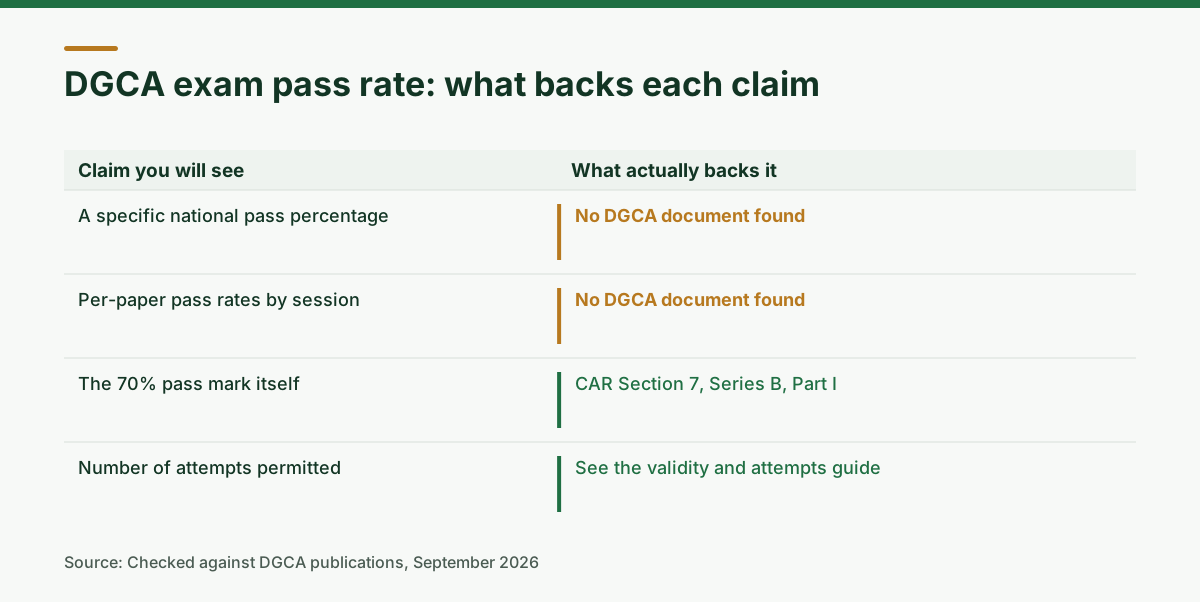
Search results for a DGCA pass rate return numbers such as a 20 to 30 percent first-attempt pass rate and a 95 percent-plus rate once resits are counted in. None of these figures link to a DGCA document. They appear on coaching and aggregator pages, and the same numbers get repeated across dozens of sites without one of them naming where the figure came from.
Two things happen every time a page repeats one of these numbers. First, it presents an estimate as if it were regulator data, which changes how a nervous candidate reads it — a "most people fail on the first try" claim lands very differently from an honest "nobody publishes this, and here is why." Second, once a number is repeated on enough pages, a search result can start to look like confirmation, even though every page traces back to the same original guess and none of them cite a source for it.
| Claim found online | Where it typically appears | What backs it |
|---|---|---|
| "20–30% pass on the first attempt" | Coaching and aggregator blogs | No DGCA document found |
| "95%+ pass eventually, with resits" | Coaching and aggregator blogs | No DGCA document found |
| "Results are generally poor, especially in Air Navigation" | Candidate forums, coaching blogs | Anecdotal; no session data cited |
| A named percentage for a specific session or year | Occasional forum posts | Self-reported by one candidate or a small group, not DGCA |
What does DGCA itself publish about results?
DGCA's Pariksha portal gives each registered candidate access to their own examination history through Candidate Login, and that is the extent of what the regulator's own Flight Crew FAQ describes. Nothing in that FAQ, and nothing in CAR Section 7, Series ‘B’, Part I, describes a public aggregate pass rate, a session-by-session results summary, or a subject-wise difficulty ranking.
The Flight Crew FAQ states plainly that a registered candidate can check their own examination history by logging in with their credentials on pariksha.dgca.gov.in.[1] That is an individual record, not a published dataset. Whether the absence of an aggregate figure is a deliberate choice or simply something DGCA has not built, the practical result is the same: there is no official number for any website to link to, which is exactly why none of them do.
| Data point | Published by DGCA? | Where, if so |
|---|---|---|
| Your own examination history | Yes | Candidate Login, pariksha.dgca.gov.in |
| Aggregate pass or fail count for a session | Not found | — |
| Pass rate by subject | Not found | — |
| Comparative difficulty ranking of the five papers | Not found | — |
| Pass mark and validity rules | Yes | CAR Section 7, Series ‘B’, Part I |
Why is a single "DGCA pass rate" the wrong number to look for in the first place?
A Commercial Pilot Licence candidate sits five independent theory papers, at different times, inside a validity window of five years, with no aggregate score across them. Asking for "the CPL pass rate" assumes one event with one outcome, and the exam is not built that way — a candidate can clear three papers this session, carry two forward, and still be, in every meaningful sense, part-way through passing.
Four structural facts make a single figure close to meaningless even if DGCA published one:
- Five separate papers, five separate results. Air Navigation, Aviation Meteorology, Air Regulation, Technical General and Technical Specific are graded independently. There is no combined "CPL result" for a session, only five individual ones.
- No aggregate score. The pass mark is 70% in each paper, so DGCA does not average performance across subjects in the first place. A population statistic built on averaging would not even match how a single candidate is judged.
- A five-year validity window. Candidates attempt papers across many sessions over years, sometimes clearing one paper long before attempting another. Any one session's numbers describe a slice of a process that is not finished.
- Two delivery routes. A paper can be sat in a regular session or through the Online On-Demand Examination. Neither route publishes separate statistics, so there is nothing to compare even at that level.
| Factor | Why it complicates a single pass-rate figure |
|---|---|
| Five independent papers | A candidate can pass some and fail others in one sitting; there is no single pass/fail outcome for "the exam" |
| No aggregate score | 70% is required per paper on its own, so DGCA never measures an "average" performance to begin with |
| Five-year validity | Attempts are spread across sessions and years, so a single session's numbers understate a candidate's eventual result |
| Regular sessions plus OLODE | Two delivery formats, neither with separately published statistics |
Does the reputation of Air Navigation as "the hardest paper" rest on any published data?
No. It is the most consistent theme across candidate forums and coaching material, for a reason that makes sense on its face — Navigation is the calculation-heavy paper, and a wrong method is harder to catch on your own than a wrong fact. But "most commonly described as hardest" is a reputation, not a DGCA statistic, and no published document ranks the five papers by difficulty.
Treat the reputation as a reasonable planning heuristic rather than a measured fact. It is consistent enough, across enough independent candidates, that budgeting extra preparation time for Navigation is sensible. It is not consistent enough, or sourced enough, to state as "X% harder" or to use as a reason to delay the paper indefinitely. Our own breakdown of what each DGCA paper actually demands goes into what makes Navigation different in practice, without attaching a number to it that nobody can support.
Does sitting a paper through OLODE change your odds compared with a regular session?
DGCA does not publish separate results data for the On-Demand route against a regular session, so there is nothing to compare. The syllabus, the pass mark and the paper itself are the same either way; what differs between the two routes is scheduling and seat availability, not grading.
If you are still deciding which route suits your timeline, that is a scheduling question rather than a results one, and our separate guide to OLODE versus regular sessions covers exactly that difference.
If a pass rate cannot tell you anything, what should you actually measure before you sit a paper?
Your own mock performance, tracked honestly, tells you more than any population statistic could. Two consecutive full-length mock papers above roughly 75%, with every marked error from the previous attempt actually corrected rather than just noted, is a stronger readiness signal than knowing what fraction of some undefined population passed last year.
A borrowed statistic describes strangers. A tracked mock score describes you, on the material you will actually be tested on, close to the date you will sit it. Use the second one.
| Signal to track | What it actually tells you |
|---|---|
| Two consecutive full mocks above ~75% | A comfortable margin above the 70% pass mark, not a borderline one |
| Marked errors from the last mock have stopped recurring | Real correction has happened, rather than the same mistake being noted twice |
| Your Air Regulation material is checked against the current CAR | Removes the single most common avoidable-failure cause candidates report |
| Navigation numericals are completed inside the time limit, not just correctly | Time pressure is a large factor in Navigation results that an untimed practice session hides |
If mock testing with marked feedback is not something you are currently getting, that is worth fixing before your next attempt. Our checklist on choosing DGCA ground classes sets out exactly what to ask a provider about how mocks are run and marked. And since DGCA does not cap the number of attempts either, our separate note on exam validity and attempts covers what actually limits you if a paper does not go your way.
How should you read the next pass-rate claim you come across?
Ask three questions before a number is allowed to change your plan: does the page name where the figure comes from, is the source DGCA's own document or someone's estimate, and would the claim still mean anything if you swapped in a different exam entirely. Most claims fail the first question on their own.
- Does it cite a document, or just state the number? A figure with no citation is an opinion wearing a percentage sign.
- Is the source DGCA, or an institute with a course to sell? An unsourced pass rate published by a training provider carries an obvious incentive either way — a low figure sells urgency, a high one sells confidence.
- Is it a first-attempt figure, an overall figure, or unspecified? These describe different things dressed as one claim, and a page that does not say which is describing neither carefully.
- Does the same number appear on many pages with no attribution trail back to one source? Wide repetition of an unsourced figure is not corroboration. It is usually just copying.
None of this means the exam is easy, or that difficulty talk is invented. It means the specific percentage attached to that difficulty is, in every case we could find, someone's estimate rather than DGCA's figure — and a plan built on your own mock results will outlast whichever number is trending on a forum this month.
Does a coaching institute's own claimed pass rate mean anything?
An institute-reported figure such as "90% of our students clear on the first attempt" is a different kind of claim from a national DGCA statistic, and it deserves separate scrutiny rather than the same shrug. It might be true. It might also be measured against a batch that includes only students who finished the course, which quietly drops anyone who left early or kept failing and stopped coming back.
Ask three follow-up questions before you weigh a number like this: what exactly counts as the batch it is measured against, does the figure include students who withdrew or paused, and will the institute show you the working rather than just the headline. An institute confident in its own number will usually answer the first two without hesitation. One that will not is telling you something about the number itself, not just about its marketing.
This is also not the same question as whether ground classes are worth paying for at all. A batch pass-rate claim is about marketing, and our separate comparison of ground classes against self-study is about the underlying decision, which stands on its own regardless of what any single institute claims about its own results.
The short version
DGCA does not publish a pass rate for its CPL or ATPL theory papers, so any specific percentage you read online is someone's estimate, not the regulator's figure. What is actually knowable: each of the five papers is graded independently at 70%, a cleared paper stays valid for five years, and your own mock-test performance is a far better predictor of your result than any population number could be. If you are still mapping the whole route, our CPL course overview sets out the licence end to end, and our comparison of ground classes against self-study is the next practical question worth answering.
Frequently asked questions
What is the DGCA CPL exam pass rate?
DGCA does not publish one. Its Flight Crew FAQ and CAR Section 7, Series B, Part I describe eligibility, the 70% pass mark and paper validity, but neither publishes an aggregate pass or fail count for any session. Any specific percentage you find online is an estimate from a coaching site or forum, not a regulator figure.
Why do different websites give different DGCA pass rate figures?
Because none of them has a source. Once an estimate is published on one page it gets repeated on others, and repetition across many pages can look like confirmation even though every page traces back to the same unverified original guess.
Is Air Navigation really the hardest DGCA paper?
It has the strongest reputation for being hardest across candidate forums and coaching material, largely because it is calculation-heavy and a wrong method is harder to self-diagnose than a wrong fact. No DGCA document ranks the five papers by difficulty, so treat this as a planning heuristic rather than a measured fact.
Does DGCA publish results for an entire exam session?
No. The Flight Crew FAQ describes only an individual examination history, viewable by a candidate through Candidate Login on the Pariksha portal. There is no public session-wide or aggregate results summary described in DGCA’s published material.
Does taking a paper through OLODE change your chance of passing compared with a regular session?
DGCA publishes no separate results data for the On-Demand route against a regular session, so there is nothing to compare. The syllabus and the 70% pass mark are the same either way; only the scheduling differs.
Does failing one DGCA paper affect your results in the others?
No. Each paper is graded independently at 70%, with no aggregate score across subjects, so a weak result in one paper has no bearing on a pass already achieved in another.
How can I estimate my own chance of passing, if there is no population figure to compare against?
Track your own full-length mock results honestly. Two consecutive mocks above roughly 75%, with every marked error from the previous attempt actually corrected, is a far more specific signal than any borrowed statistic.
Where can I check my own DGCA examination history?
Through Candidate Login on the Pariksha portal, using the credentials tied to your computer number. That is the individual record DGCA describes in its Flight Crew FAQ.
No. The Flight Crew FAQ describes only an individual examination history, viewable by a candidate through Candidate Login on the Pariksha portal. There is no public session-wide or aggregate results summary described in DGCA's published material.
Does taking a paper through OLODE change your chance of passing compared with a regular session?
DGCA publishes no separate results data for the On-Demand route against a regular session, so there is nothing to compare. The syllabus and the 70% pass mark are the same either way; only the scheduling differs.
Does failing one DGCA paper affect your results in the others?
No. Each paper is graded independently at 70%, with no aggregate score across subjects, so a weak result in one paper has no bearing on a pass already achieved in another.
How can I estimate my own chance of passing, if there is no population figure to compare against?
Track your own full-length mock results honestly. Two consecutive mocks above roughly 75%, with every marked error from the previous attempt actually corrected, is a far more specific signal than any borrowed statistic.
Where can I check my own DGCA examination history?
Through Candidate Login on the Pariksha portal, using the credentials tied to your computer number. That is the individual record DGCA describes in its Flight Crew FAQ.
More: the FAQ for short sourced answers, the glossary for the terms, and our editorial policy for how these figures are checked.
- DGCA Exam Pass Rate
- DGCA Exam Difficulty
- CPL Pass Percentage
- DGCA Exams
Sources
Every figure above traces to one of these documents. Where a claim could not be sourced, the page says so instead of repeating it.
- DGCA Pariksha Flight Crew FAQ
- CAR Section 7, Series B, Part I
Related reading
- Choosing TrainingDGCA Ground Classes vs Self-Study: Which Route Actually Clears the Exams?TL;DR: DGCA ground classes are not mandatory. CAR Section 7, Series B, Part I requires only a DGCA computer number and a 10+2 pass with Physics and Mathematics to appear for CPL theory papers. Ground classes are a study decision, not a licensing one — worth buying for Air Navigation and Air Regulation, and usually skippable for Technical General and Meteorology if your PCM base is current.
- DGCA ExamsCommon Misconceptions About DGCA Exams: What the Rules Actually SayMost of what circulates about DGCA exam eligibility is wrong in the same few ways. Chemistry is not required. There is no maximum age. Ground classes are not mandatory. Each correction below is checked against DGCA's own published rules, with the source named.
- DGCA ExamsDGCA Exam Validity and Attempts: What Is Published, and What Is NotA cleared CPL or ATPL theory paper stays valid five years. A cleared PPL paper stays valid two and a half. DGCA publishes no limit on attempts, so what actually constrains you is that window and a non-refundable fee on every try.