
The three pilot licences share almost nothing at the examination stage. Different subjects, different entry qualifications, different validity on a cleared paper. Confusing them is the most common planning error in Indian pilot training, and it is expensive, because a paper cleared under the wrong assumption can expire before you use it.
Key facts
- A PPL candidate appears on a pass in Class Ten or equivalent; a CPL candidate on 10+2 with Physics and Mathematics.Sourced: CAR Section 7, Series B, Part I
- The pass mark is 70% in each paper, with no aggregate across papers.Sourced: CAR Section 7, Series B, Part I
- A PPL paper expires in two and a half years, against five for CPL and ATPL.Sourced: CAR Section 7, Series B, Part I
On this page
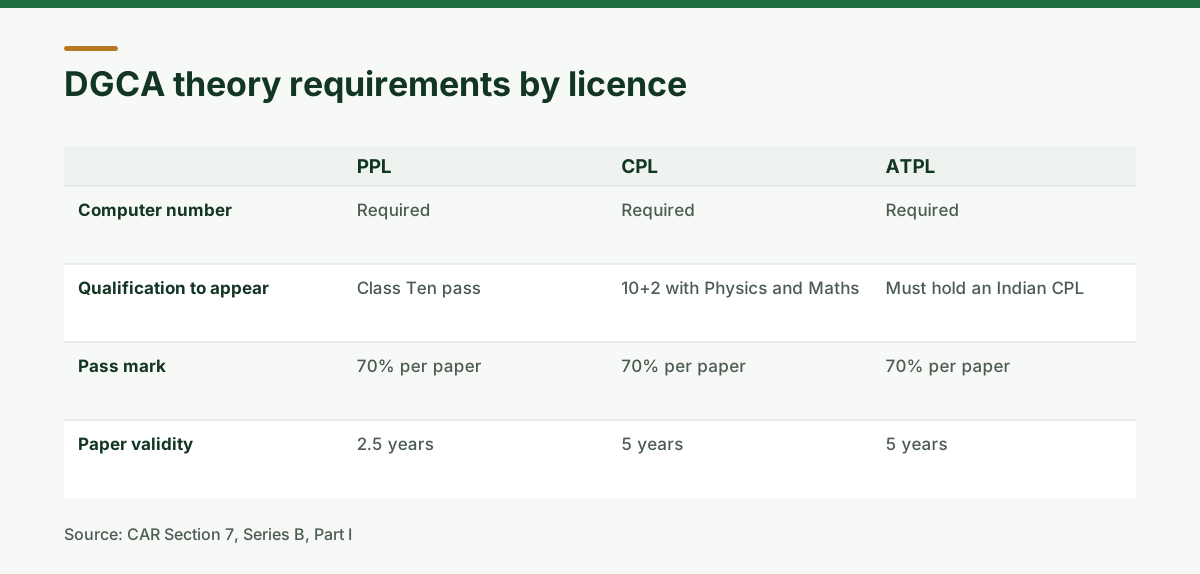
The full comparison
| PPL | CPL | ATPL | |
|---|---|---|---|
| Computer number | Required | Required | Required |
| Qualification to appear | Passed Class Ten or equivalent | Passed 10+2 with Physics and Mathematics | Must hold an Indian CPL |
| Subjects | Composite Paper; Aircraft & Engine / Instruments in general and specific | Air Navigation; Aviation Meteorology; Air Regulation; Aircraft & Engine / Instruments in general, specific and performance | Air Navigation; Aviation Meteorology; Air Regulation; Radio Aids and Instruments; Aircraft & Engine / Instruments in general, specific and performance; plus Oral |
| Pass mark | 70% per paper | 70% per paper | 70% per paper and 70% in the oral |
| Validity of a cleared paper | Two and a half years | Five years | Five years |
| Aircraft restriction | — | — | Not issued on a single-engine aircraft |
Source: DGCA CAR Section 7, Series ‘B’, Part I (Issue III, 24 March 2017, Revision 2, 13 February 2019).
Illustration in production
Three things this table settles
A PPL does not need 10+2 with PCM
It needs a pass in Class Ten or equivalent. The 10+2 with Physics and Mathematics rule is a Commercial Pilot Licence rule, and applying it to the PPL turns people away who are eligible.
A PPL paper expires in half the time
Two and a half years, against five for CPL and ATPL. If you clear PPL papers and then pause — for money, for a medical, for a flying slot — they lapse considerably sooner than the five-year figure everyone quotes. Stage PPL attempts against when you will actually be flying.
An ATPL is not a first licence
DGCA states an ATPL applicant should hold an Indian CPL. The exception is for defence personnel, who may qualify instead on 500 hours of flying experience including 200 as Pilot-in-Command. And the ATPL is not issued on a single-engine aircraft — a constraint that shapes which aircraft your hours need to be on, and that almost no guide mentions.
Illustration in production
What sits outside these papers
RTR(A), the Radio Telephony Restricted (Aeronautical) licence, is a separate examination with its own syllabus and a practical component. It is not one of the theory papers above, it is not covered by a typical ground-class package, and its administration has moved between authorities — confirm the current examining body before you apply.
Technical Specific is aircraft-type specific. Your source material is the manual for the type you nominate, not a general coaching handout, and no package covers every type.
Illustration in production
How to sequence them
- Get the computer number first. Nothing can be booked without it, and for new candidates it requires a posted hard copy and a Board Verification Certificate.
- Start with the stable subjects. Aviation Meteorology and the general technical paper change least and reward self-study best.
- Treat Air Regulation as perishable. It is built on CARs and circulars that get revised. Studying it from an old edition is the most common avoidable failure.
- Stage attempts against validity, not ambition. Two cleared papers are banked. Four half-prepared papers are four non-refundable fees.
Illustration in production
Frequently asked questions
How many papers are there for a CPL in India?
DGCA lists Air Navigation, Aviation Meteorology, Air Regulation, and Aircraft and Engine / Instruments in general, specific and performance. RTR(A) is a separate radio-telephony examination outside this set.
What subjects does the PPL exam cover?
A Composite Paper, and Aircraft and Engine / Instruments in general and specific. The PPL set is smaller than the CPL set.
What is the pass mark for DGCA theory papers?
70% in each paper. There is no aggregate across papers, so a strong score in one subject cannot compensate for a shortfall in another. For the ATPL, the 70% requirement applies to the oral examination as well.
How long does a cleared DGCA paper stay valid?
Five years for CPL and ATPL papers. Two and a half years for PPL papers — a distinction that is rarely stated and that changes how you should stage attempts.
Can I take the ATPL exam without a CPL?
DGCA states an ATPL applicant should hold an Indian Commercial Pilot Licence. Defence personnel may instead qualify on 500 hours of flying experience, of which 200 should be as Pilot-in-Command.
Is an ATPL issued on a single-engine aircraft?
No. DGCA states an ATPL licence is not issued on a single-engine aircraft.
Related
Syllabus and eligibility are revised periodically. Verify against the current CAR before planning around any of this.
More: the FAQ for short sourced answers, the glossary for the terms, and our editorial policy for how these figures are checked.
- DGCA Subjects
- CPL Syllabus
- ATPL Subjects
- PPL Exams
Sources
Every figure above traces to one of these documents. Where a claim could not be sourced, the page says so instead of repeating it.
- CAR Section 7, Series B, Part I
Related reading
- DGCA ExamsDGCA OLODE vs Regular Sessions: How On-Demand Flight Crew Exams WorkDGCA conducts Flight Crew examinations in scheduled sessions and through the Online On-Demand Examination route, where you pick a slot instead of waiting for a session date. The eligibility, the syllabus and the 70% pass mark are identical either way. What changes is timing, and how much control you have over it.
- DGCA ExamsCommon Misconceptions About DGCA Exams: What the Rules Actually SayMost of what circulates about DGCA exam eligibility is wrong in the same few ways. Chemistry is not required. There is no maximum age. Ground classes are not mandatory. Each correction below is checked against DGCA's own published rules, with the source named.
- DGCA ExamsDGCA Board Verification Certificate: What It Is and Who Needs OneA Board Verification Certificate is issued by your school board to certify that your mark sheet is genuine. DGCA requires one from every NEW Flight Crew candidate before registration, for Indian and foreign candidates alike. Candidates who already held a computer number before the Pariksha portal launched do not need one.