
A cadet pilot programme and a self-sponsored Commercial Pilot Licence lead to the identical DGCA licence, issued under the same rules either way. The difference is sequence and risk: a cadet programme selects you before training and typically attaches a service bond afterward, while a self-sponsored CPL has you choose the school, fund each stage yourself, and search for a job only once training ends.
Key facts
- A cadet pilot programme and a self-sponsored CPL both require a DGCA computer number and a pass in 10+2 with Physics and Mathematics; the licensing route does not differ between them.Sourced: CAR Section 7, Series B, Part I
- The DGCA theory exam fee is Rs 2,500 per paper, fixed regardless of which route brought a candidate to the exam.Sourced: DGCA Pariksha Flight Crew FAQ
- The pass mark is 70% per paper with no aggregate, and a cleared paper stays valid five years, for every CPL candidate regardless of route.Sourced: CAR Section 7, Series B, Part I
On this page
- What is a cadet pilot programme?
- What is the self-sponsored CPL route?
- Does DGCA license a cadet-programme pilot differently from a self-sponsored one?
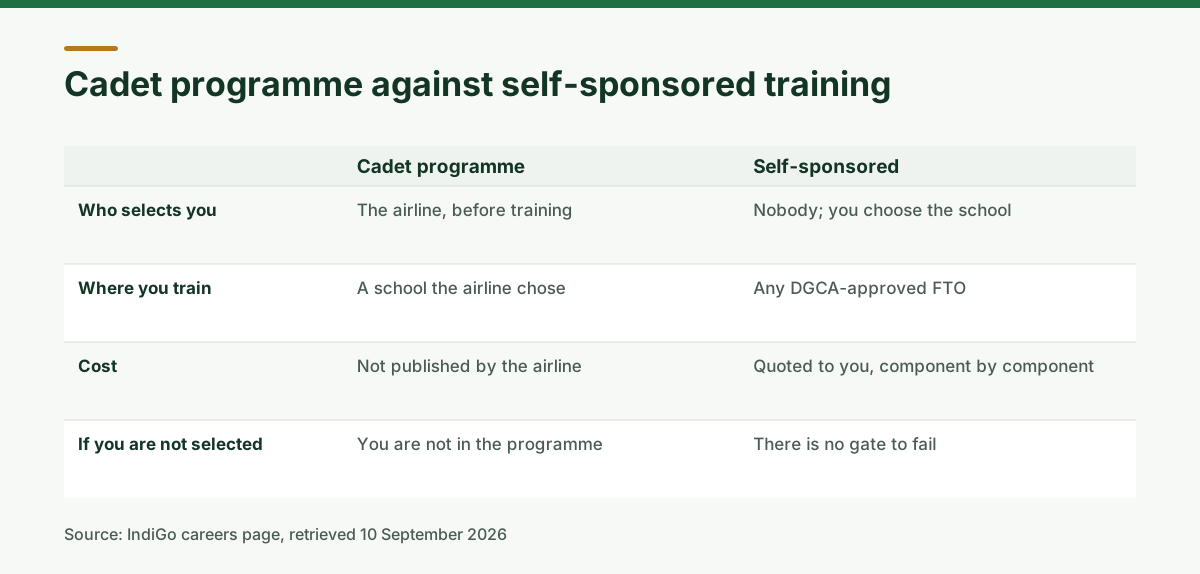
- What structurally differs between a cadet programme and self-sponsored CPL?
- How much does each route actually cost?
- What is a training bond, and why does it usually attach to cadet programmes?
- Which route suits which kind of candidate?
- What should you verify before committing to either route?
- The short version
- Frequently asked questions
What is a cadet pilot programme?
A cadet pilot programme is an airline-linked route in which an airline, working through one or more partner Flying Training Organisations, selects candidates through an assessment process before training begins, then carries them through Commercial Pilot Licence training, a multi-engine and instrument rating, and usually a type rating, with a defined route toward a First Officer role at the end.
The word “cadet” suggests employer-funded training, and outside India that is sometimes the case. The standard Indian model is different. Candidates typically still fund their own training, often through an education loan, and what the airline actually contributes is a training partner, a structured syllabus, a fixed cohort timetable, and — contingent on completing the programme and meeting its standards — a defined route into a First Officer seat. That is a real difference from self-sponsored training, but it is not the same as tuition being paid for you, and any programme description that lets you assume otherwise is worth questioning directly with the airline or its partner FTO.
Selection in these programmes usually runs in stages: an aptitude or cognitive assessment, a group exercise, and a personal interview, in some order, before an offer is made. The exact stages, pass criteria, and sequence differ by airline and change between intakes, so treat any specific description of “the” selection process, including a general one like this, as a starting point to verify against the current programme notice, not a fixed procedure.
What is the self-sponsored CPL route?
Self-sponsored CPL training is the route where you choose your own DGCA-approved Flying Training Organisation, fund each stage of training as it happens, work through the DGCA theory papers on your own schedule, and apply to airlines independently once you hold a licence. No airline selects you before training starts, and none is committed to hiring you after.
That absence of a placement guarantee is the trade against the flexibility this route offers. You choose the FTO, the city, the pace, and whether to take ground classes or study independently — a decision our guide to CPL eligibility after 12th and our comparison of ground classes against self-study both cover in detail. What you do not get is a cohort timetable enforced by an airline partnership, or an airline waiting to interview you the day your licence clears. Building flying hours as an instructor, or applying to cadet-style pathways after the fact, are both common next steps once a self-sponsored CPL is in hand.
Does DGCA license a cadet-programme pilot differently from a self-sponsored one?
No. DGCA sets one set of requirements for a Commercial Pilot Licence, and both routes satisfy the identical requirements: the same computer number, the same 10+2 Physics-and-Mathematics qualification, the same five theory papers at 70% each, the same medical class, and the same RTR(A) certificate. The airline’s involvement changes the training sequence and the cost structure. It does not create a separate class of licence.
| DGCA requirement | Cadet-programme candidates | Self-sponsored candidates |
|---|---|---|
| DGCA computer number | Required | Required |
| 10+2 with Physics and Mathematics | Required | Required |
| Theory papers: Air Navigation, Aviation Meteorology, Air Regulation, Technical General, Technical Specific | Same five papers | Same five papers |
| Pass mark | 70% per paper, no aggregate | 70% per paper, no aggregate |
| Validity of a cleared paper | Five years | Five years |
| Exam fee | ₹2,500 per paper | ₹2,500 per paper |
| RTR(A) certificate | Required | Required |
| Flight experience under Schedule II | Required, logged at the partner FTO | Required, logged at the candidate’s chosen FTO |
Source: DGCA CAR Section 7, Series ‘B’, Part I, and the DGCA Pariksha Flight Crew FAQ. Both apply identically to every CPL candidate, regardless of how their training was arranged.
What structurally differs between a cadet programme and self-sponsored CPL?
Five things actually differ: who selects you and when, who chooses the training organisation, whether a type rating is bundled in, whether a job is attached at the end, and whether a service bond follows training. Everything else — the regulatory path itself — is the same.
| Dimension | Cadet programme | Self-sponsored CPL |
|---|---|---|
| Selection point | Before training begins, through the airline’s own process | Not applicable — you enrol yourself at an FTO of your choosing |
| Choice of training organisation | Fixed to the airline’s partner FTO or FTOs | Yours to choose and compare |
| Type rating | Usually bundled into the programme | A separate purchase after the CPL, at a training provider you choose |
| Job outcome | A defined route toward a First Officer role, contingent on completing training and meeting standards | No placement attached; you apply independently once licensed |
| Who funds training, and when | You, typically through savings or an education loan, on the programme’s payment schedule | You, on a schedule you set stage by stage |
| Commitment after training | Typically a service bond with the sponsoring airline | None — you are free to apply anywhere |
| Pace and schedule | A fixed cohort timetable set by the programme | Set by you, within what your chosen FTO can schedule |
| DGCA licensing requirement | Identical to self-sponsored — see the table above | Identical to a cadet programme — see the table above |
How much does each route actually cost?
Neither DGCA nor any Indian airline publishes a centralised fee figure for a cadet programme or for a self-sponsored CPL, and the third-party numbers circulating for either route disagree with each other too widely to repeat responsibly. The one cost component that is genuinely fixed and published, regardless of route, is the DGCA exam fee itself.
This is not an oversight on any single site’s part. A cadet programme’s total cost depends on which airline, which partner FTO, which aircraft type, and which intake you join. A self-sponsored CPL’s cost depends on the FTO you choose, the city, single-engine versus multi-engine hours flown, and how efficiently you complete the syllabus. None of those variables has one answer, so no one figure can honestly describe “the cost” of either route.
| Cost component | Set by | Centralised published figure? |
|---|---|---|
| DGCA theory exam fee | DGCA | Yes — ₹2,500 per paper, per the Pariksha Flight Crew FAQ |
| Flying hours and ground training | The individual FTO | No single published figure; varies by school and aircraft |
| Cadet programme package fee | The individual airline–FTO partnership | No centralised figure we could verify against a primary source |
| Type rating | The individual training provider | No centralised figure we could verify against a primary source |
| Service bond repayment, if triggered | The individual airline–candidate agreement | Not published; contract-specific |
Treat any specific rupee figure you read for a cadet programme or a self-sponsored CPL, on this site or elsewhere, as one provider’s number, not an industry figure. Ask the airline or the FTO directly, in writing, for the figure that applies to the exact programme and intake you are considering.
What is a training bond, and why does it usually attach to cadet programmes?
A training bond is a contractual commitment to work for the sponsoring airline for a set period after training completes, usually carrying a repayment obligation if you leave before that period ends. It attaches to cadet programmes because the airline’s side of the arrangement is a placement route, and the bond is how it protects that commitment. A self-sponsored candidate, who applies to airlines independently with no placement offered in advance, typically has no such bond to negotiate.
A bond is a contract between you and the airline or its FTO partner, not a DGCA requirement, so it will not appear in any DGCA document and DGCA has no role in enforcing or waiving it. That makes it entirely negotiable in principle and entirely your responsibility to read closely in practice. Before signing anything, get answers in writing to:
- The exact duration of the service commitment, stated in months or years, not as “a few years” or “standard terms.”
- The repayment formula if you leave early — a flat figure, a pro-rated amount tied to time served, or the full training cost regardless of how much of the bond period you completed.
- What counts as a trigger. Resignation is the obvious one; check whether medical grounding, a failed check ride, or the airline itself ending your role also counts against you.
- Whether the bond is enforceable against you personally, a guarantor, or both, since some agreements ask for a third-party guarantor alongside the cadet.
None of this is DGCA territory, so no rulebook will settle a dispute for you. A contract you have read in full, with these four points answered in writing before you sign, is the only real protection.
Which route suits which kind of candidate?
Neither route is the objectively better one; each suits a different tolerance for structure, timing, and commitment. Match the route to how you actually want the next several years to run, not to which one sounds more prestigious.
A cadet programme tends to suit you if
- You want the earliest possible line of sight to a specific airline, and are comfortable being evaluated against its selection criteria rather than choosing your own path.
- A fixed cohort timetable, set by someone else, suits how you work better than an open schedule would.
- You are willing to commit to a multi-year service period in exchange for a defined route into a First Officer seat.
- You would rather have the type rating decision made for you, on the airline’s own fleet, than choose it separately later.
Self-sponsored CPL tends to suit you if
- You want to choose your own FTO, city, and pace, and are prepared to do the comparison work our guide to choosing a flying school sets out.
- You do not want a service bond, or want to keep your options open across multiple airlines rather than committing to one before training even starts.
- You are comfortable applying to airlines and building your own case — hours, a type rating, an instructor rating — after your CPL rather than having a placement route defined in advance.
- Your intake timing, city, or budget does not line up with any cadet programme currently open.
What should you verify before committing to either route?
The verification habit differs by route, because the risks differ. A cadet programme concentrates risk in the selection process and the bond; a self-sponsored CPL concentrates it in the training organisation and the job search afterward.
Before joining a cadet programme
- Get the selection stages and pass criteria in writing, not as a verbal summary from a counsellor.
- Get the total programme fee, a full list of what it includes and excludes, and the payment schedule, before you commit any money.
- Get the exact bond duration and repayment formula in writing, per the checklist above.
- Ask directly what happens if you do not meet the programme’s standards partway through — a refund policy, a repeat opportunity, or neither.
- Confirm the partner FTO carrying out the actual flight training is DGCA-approved, using the same checks our flying-school guide recommends for any FTO.
Before starting a self-sponsored CPL
- Confirm the FTO’s DGCA approval status directly, not from its own marketing.
- Confirm whether ground classes are bundled into the FTO’s fee or sold separately, and whether attending them is contractually required or optional.
- Register for your DGCA computer number and plan your RTR(A) registration early — both run through the same Pariksha-portal system regardless of route, and neither depends on being in a cadet programme.
- Budget the type rating as a separate cost that comes after the CPL, not as something the FTO fee already covers.
The short version
A cadet pilot programme and a self-sponsored CPL both end at the same DGCA Commercial Pilot Licence, cleared through the identical computer number, theory papers, pass mark and medical requirement. What differs is sequence and risk: a cadet programme selects you first, usually bundles a type rating, and typically attaches a service bond; a self-sponsored CPL has you choose the FTO, fund each stage independently, and apply for jobs only once training is complete. Neither route has a centralised published cost, so treat any specific figure you read, including anywhere on this site, as one provider’s number rather than an industry standard. For the regulatory groundwork either route sits on, see our DGCA information hub and our CPL course page.
Frequently asked questions
Does a cadet pilot programme give a different pilot licence from a self-sponsored CPL?
No. Both routes lead to the same DGCA Commercial Pilot Licence, issued under the same eligibility, theory papers, pass mark and medical requirement. The airline’s involvement changes the training sequence and cost structure, not the licence itself.
Do I still need to pass the DGCA theory exams if I join a cadet programme?
Yes. Cadet-programme candidates sit the same Air Navigation, Aviation Meteorology, Air Regulation, Technical General and Technical Specific papers at the same 70% pass mark as anyone self-sponsoring their CPL. The programme structures when you study; it does not change what DGCA requires you to pass.
Is a cadet pilot programme free, or airline-sponsored in the financial sense?
Not in the Indian model as it commonly runs. Candidates typically fund the training themselves, often through an education loan, while the airline contributes a training partner, a structured syllabus and a defined route toward a First Officer role. Confirm the exact funding structure of any specific programme before assuming “sponsored” means free.
What is a training bond, and does self-sponsored CPL have one?
A training bond is a contractual commitment to work for the sponsoring airline for a set period after training, usually with a repayment obligation if you leave early. It is a common feature of cadet programmes because the airline is offering a placement route. A self-sponsored CPL, where you apply to airlines independently afterward, typically carries no such bond.
Which is cheaper, a cadet programme or self-sponsored CPL?
Neither airlines nor DGCA publish a centralised figure for either route, and the third-party numbers in circulation vary too widely between sources to repeat responsibly. What is fixed regardless of route is the DGCA exam fee of ₹2,500 per paper; every other cost component is set by individual training providers and differs by school, aircraft and cohort.
Does a cadet programme guarantee me an airline job?
It offers a defined route toward one, contingent on completing training and meeting the standards the programme sets, not an unconditional guarantee. Ask any specific programme what happens if a cadet does not meet those standards partway through, since the answer differs by airline and partner FTO.
Can I do a self-sponsored CPL and still apply to a cadet-style airline pathway later?
Yes. A self-sponsored CPL holder can apply to airline recruitment drives and, in some cases, structured pathway programmes the same as any other qualified candidate. The DGCA licence is identical either way, so having self-sponsored your training does not disqualify you from later airline selection.
How do I choose the flying school behind either route?
The verification questions are the same either way: confirm the FTO’s DGCA approval, its aircraft availability, and its actual completion timeline rather than the one advertised, before committing to a cadet programme’s partner FTO or to an FTO you are choosing yourself.
No. Both routes lead to the same DGCA Commercial Pilot Licence, issued under the same eligibility, theory papers, pass mark and medical requirement. The airline’s involvement changes the training sequence and cost structure, not the licence itself.
Do I still need to pass the DGCA theory exams if I join a cadet programme?
Yes. Cadet-programme candidates sit the same Air Navigation, Aviation Meteorology, Air Regulation, Technical General and Technical Specific papers at the same 70% pass mark as anyone self-sponsoring their CPL. The programme structures when you study; it does not change what DGCA requires you to pass.
Is a cadet pilot programme free, or airline-sponsored in the financial sense?
Not in the Indian model as it commonly runs. Candidates typically fund the training themselves, often through an education loan, while the airline contributes a training partner, a structured syllabus and a defined route toward a First Officer role. Confirm the exact funding structure of any specific programme before assuming “sponsored” means free.
What is a training bond, and does self-sponsored CPL have one?
A training bond is a contractual commitment to work for the sponsoring airline for a set period after training, usually with a repayment obligation if you leave early. It is a common feature of cadet programmes because the airline is offering a placement route. A self-sponsored CPL, where you apply to airlines independently afterward, typically carries no such bond.
Which is cheaper, a cadet programme or self-sponsored CPL?
Neither airlines nor DGCA publish a centralised figure for either route, and the third-party numbers in circulation vary too widely between sources to repeat responsibly. What is fixed regardless of route is the DGCA exam fee of ₹2,500 per paper; every other cost component is set by individual training providers and differs by school, aircraft and cohort.
Does a cadet programme guarantee me an airline job?
It offers a defined route toward one, contingent on completing training and meeting the standards the programme sets, not an unconditional guarantee. Ask any specific programme what happens if a cadet does not meet those standards partway through, since the answer differs by airline and partner FTO.
Can I do a self-sponsored CPL and still apply to a cadet-style airline pathway later?
Yes. A self-sponsored CPL holder can apply to airline recruitment drives and, in some cases, structured pathway programmes the same as any other qualified candidate. The DGCA licence is identical either way, so having self-sponsored your training does not disqualify you from later airline selection.
How do I choose the flying school behind either route?
The verification questions are the same either way: confirm the FTO’s DGCA approval, its aircraft availability, and its actual completion timeline rather than the one advertised, before committing to a cadet programme’s partner FTO or to an FTO you are choosing yourself.
More: the FAQ for short sourced answers, the glossary for the terms, and our editorial policy for how these figures are checked.
- Cadet Pilot Programme
- Self-Sponsored CPL
- Airline Cadet Programme India
- CPL vs Cadet Programme
Sources
Every figure above traces to one of these documents. Where a claim could not be sourced, the page says so instead of repeating it.
- CAR Section 7, Series B, Part I
- DGCA Pariksha Flight Crew FAQ
Related reading
- CareerFrozen ATPL Explained: What the Term Actually Means Under DGCA RulesTL;DR: Frozen ATPL is not a DGCA licence. It is industry shorthand, borrowed from EASA's integrated-course rule, for a CPL holder who has cleared ATPL theory but not yet logged the flight hours a full ATPL needs. DGCA's own CAR names only a CPL and an ATPL, with nothing labelled "frozen" between them.
- CareerJobs After CPL in India: What a Commercial Pilot Licence Actually Qualifies You ForTL;DR: A Commercial Pilot Licence authorises paid flying; it does not assign an airline job. DGCA's own documents set no minimum-hours threshold for airline hiring — that figure is each carrier's own policy. Most CPL holders in India build hours first as instructors, or on charter, cargo or regional aircraft.
- CareerType Rating Cost in India: Why No Two Quotes MatchTL;DR: No DGCA document sets or publishes what a type rating costs in India. Each Type Rating Training Organisation prices its own course, so the wide range of figures you find online are marketing numbers, not a regulated fee. What actually moves the cost is aircraft type, simulator location, group size and whether an airline or you are paying.